
Mythic Bastionlands Review
By Dean | March 9, 2026
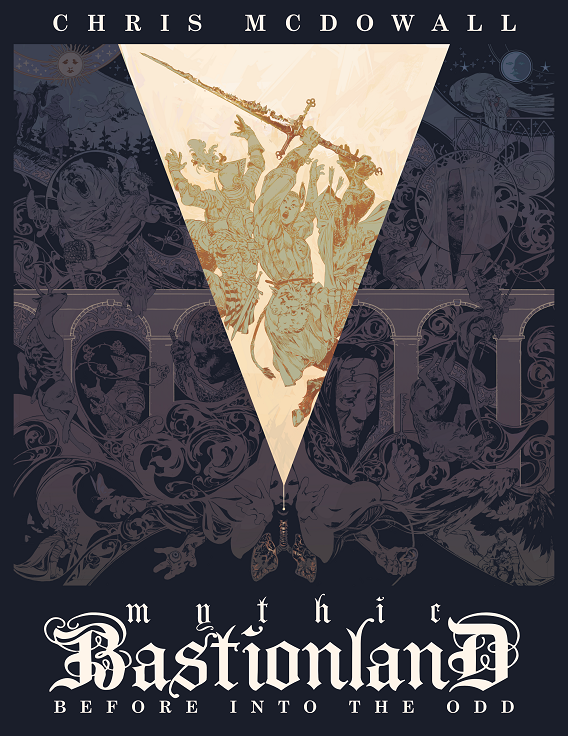
It’s been awhile my friends! For me its been quite a few busy months of adjusting to a new job and seeing where things fall for a lot of different things in my life. One thing that of course has stayed the same is my ravenous appetite for new and interesting games. I have quite a banger for you this time too.
A Fantasy Game Unlike Any Other
Mythic Bastionlands is like nothing I have ever played or run before. It’s a fantasy game with the eerie backdrop of a kingdom beset by myths (and those myths are WILD). You are one of 72 knights who were knighted by one of the 72 seers, given strange and fantastical powers in order to help keep the realm safe and together. Within this framework you work together with your fellow players across a sprawling map to find what is plaguing the kingdom and through the seers wisdom, how to stop it.
The knights that the players are assigned range from the obsurd to the most heavy metal you can imagine. Here are two instances of knights the player characters might roll up. In play players would randomly recieve a knight by rolling a d6+d12.
Knight Examples
Gilded Knight

The gilded knight draws thier power from their coming Martyrdom. Whenever they recieve a mortal wound, all allies gain 6 guard and get +d12 against the opponent who downed them. They also possess a mask which give them an additional point of armor, as well anyone who desires or knows the value of the gold are impaired on their first attack.
Barbed Knight

The barbed knight draws them power from the blood of their enemy. Should they possess a victims blood, they can apply it to an arrow and roll +d12 with the normal dice for the bow. As well should they taste it, it will show their location to the knight. Their spear also does an additional +d8 against a target you have wounded or scarred.
The Hex Crawl That Doesn’t Slow You Down
This does play out as a giant hex crawl but its faster than you would think. The players potentially could move across the map several times during a play session. There is a ticking clock (which are the myths we will talk about here in a few), but otherwise if the hex is empty or isn’t really apart of the grander story, then the players will move through it in a matter of moments. This is to give them a feel of the scale without really slowing down the game. The players can also “rush” through more than 1 hex at a time if they push their horses, so if speed matters you can really ramp up the tension and give them the feel of rushing to make it to a hex before their horses give out. All and all its pretty elegant way of having the discovery and excitement of a hex crawl but also being able to see most of the map in a session or two.
Myths and Seers: The Heart of the Game
The myths and seers are were this game hits just right for me. The myths are essentially a series of prompts and events that occur where the myths begin to shape the realm to their design. In a full campaign there are 6 myths going all at the same time. Every time the knights move a hex, a simple d6 is rolled and a chart is checked against the roll. It can tick the nearest myth’s cycle or a random one, or something much more benign such as finding a clean well or finding a vantage point to see more of what is out there. The myths themselves generally have 6-8 events that occur before they are “fully set” and the final prompt is generally a call to action. One of the most interesting parts of most myths is that its possible to head them off before they are fully realized and doing so gives the players a big advantage over whatever is happening. As an example, one myth is the growing of a giant boar and its mutant family. If the players manage to find the boars before the end of the myth cycle the boars are not the giants that can crush walls and devour villagers yet, still dangerous but not realm threateningly so.
The Seers Are Heavy Metal
The seers are another really heavy metal addition to the game. They are people who have been transformed in some way to be able to see the future. Thing ranges from pretty simple and strange (a seeing who dressed in endless jewelry and sees the world through every gemstone in the realm) to super hardcore death metal band cover (A seer who is sealed inside of a bronze statue of himself set over an eternal fire who is constantly burned inside screaming out prophecies of doom and being able to know of any event in the realm where someone was in pain). Seers generally have the ability to see either the future, the past or both but under as special condition. Seers also give the game that little bit extra of strange to set the tone of the game but are invaluable for knights who need to understand the omens they have seen. It’s also yet another wonderful way to make the players want to transverse the map.
Combat: Dice Pools and Gambits
Mythic Bastionlands also has a super unique combat system. Each combatant rolls every dice their weapons can produce (So knight with a 2d6 sword and 1d4 shield, rolls all of those dice together) and you build a kind of combat dialogue with those rolls. The highest roll per side becomes the damage done to the opposing side, with any dice of 4 or higher become a “gambit” which allows characters to pin weapons, shields, etc if the opposing force fails a saving throw. You can also increase the amount of damage the primary attacker is doing by 1. Any dice of 8+ can force normal gambits without a saving throw or choose from longer lasting gambits with a saving throw such as shattering shields, disarming a foe, etc. This effects are mostly at the whim of the GM, so if an agreement can be made between the player and the GM it flies! It’s super fun to see how each combat round goes, when things are one big group roll, you can finish whole combats in like 10 minutes, with glorious turn abouts and detailed play by plays as the gambits fly. Knights also have the ability to perform feats, which allow them to do basically super charged attacks, gambits or remove opposing dice from their attackers pool but have to test to see if the feat exhausts them. If it does they can’t do it again until they have a chance to “recover from the battle” which is a nebulous way of saying, when the fight is over and the GM thinks they have caught their breath.
The Old School Hex Crawl, Modernized
All and all its a pretty fun and loose system in the idea of the original TSR style hex crawls, where the GM lays out basic ideas and lets the players wander around a map with a general idea of what needs doing. There is of course a lot of nuance for how you can keep a game like mythic Bastionlands rolling, but after a session or two you can really feel how in a few hours you can replicate what feels like months of a D&D campaign.
The Rough Edges
As with any system however there are some flaws with the approach taken with Mythic Bastionlands. The biggest complaint is that the combat system can feel very odd if you have multiple people fighting side by side. Singular combat just feels odd when you may only be rolling 1 dice vs another 1 or 2 dice from your opponent. The best way I’ve seen this work is to make it an “opposing force” and give the “squad” a bit more hit points but a lot more dice. So they can perform more gambits and the likes to scale a little bit better with the players. Speaking of scale, that is something that I’ve struggle with a bit here and there. It’s difficult to know exactly what is going to be a breeze and what will absolutely devastate your players. My best advice to this is keep dice like d10s or d12s reserved for only the biggest bads. Default to d8s with extra d6s for backup for your bad guys. It easier to keep it from knocking out one of your players wholesale with a lucky 12 against a exhausted knight. That being said, it is partially a horror game, so keeping that kind of edge to your combats may be in the interest of keeping that tension.
Final Thoughts: Lean Into the Weird
My final word on this is really lean into the myths. Let them seem strange and fantastical and definitely give your players reasons to seek the Seers. One of the best parts of being a GM of Mythic Bastionlands is being able to drop the insanity that is the Seers on your players. Wither they are are speaking to a seer inside of a giant jar of soil that blooms flowers of different colors to tell them yes or no, or acolytes divine exactly how the pig demon seer ate an oyster dish to explain the coming daught. Keep them weird and give the players reasons to understand why they don’t live with normal folks.
Should you desire a copy of Mythic Bastionlands of your very own (and I highly recommend you do!) you can get it here.
DriveThru RPG - Mythic Bastionlands
Bonus Extras
I ran this game at a convention (which I will do a write up on, because I had a lot of fun and have some good pictures from it!) and I came up with a fun way of doing this. Using the map generator: mythic.bastionland.tools. I was able to make a player map, then sent it off to Office Depot’s print department to turn it into a poster. I had them lamenate it and honestly, it turned out awesome. From there, I made some icons for the special features found on the various maps. I’ll include those files in case you want to give it a try. They are a Bambu Studio 2 color print using an AMS. I know not a ton of people have those, but it really did turn out nice! As always you can just use paper tokens, just need to add some weight to them so a sneeze doesn’t clear your board!